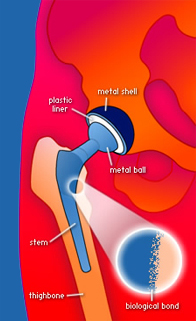
Total hip prosthesis
A total hip prosthesis replaces the worn ball-and-socket joint with artificial parts designed to move smoothly and fix securely to bone.
Key components
- Metal socket shell with a highly cross-linked polyethylene liner
- Femoral stem placed into the thigh bone
- Metal or ceramic ball attached to the stem
- Cemented or uncemented fixation, depending on the patient
Components
The artificial socket is usually made of an outer metal shell and an inner plastic liner. The femoral side includes a stem inserted into the thigh bone and a ball that fits into the socket liner.
Cemented or uncemented fixation
The prosthesis can be attached to bone with surgical bone cement or without cement. In an uncemented hip replacement, the implant initially relies on a tight fit. Over time, bone grows onto or into the porous surface of the implant and forms a biological bond. In my practice, I usually use uncemented total hip implants, while still individualizing the decision to bone quality, age, anatomy, and the surgical situation.
Bearing surfaces
The bearing surface is the part of the hip replacement that moves. The most common modern bearing is a ceramic or metal ball moving against a highly cross-linked polyethylene liner. This combination has excellent wear characteristics and avoids some of the problems seen with older bearing designs.
Ceramic-on-ceramic bearings can have low wear, but they may be associated with rare squeaking or ceramic-specific complications. I therefore do not routinely use ceramic-on-ceramic total hip bearings. Large-head metal-on-metal total hip replacements are also no longer used routinely because many older designs had higher failure rates, adverse local tissue reactions, and elevated metal ion concerns.